Scoil Bhríde Fundraiser….. Go to the dogs!!!
A night at the dogs to fundraise for our school, Scoil Bhríde, will take place this Friday evening at 8 O’clock, February 12th at The Greyhound Track, College Road, Tickets are €25 which includes family admission, race card and a buster race number. The top prize for the Buster Race is €1500 and there are 5 lucky dip prizes of €100. This is a fun night for all the community and family for a worthy cause.
Holy Icon Exhibition.
A Holy Icon Exhibition takes place in the Tertiary Hall, St. Mary’s, the Claddagh, from Friday, March 12th until Tuesday, March 16th. The official opening of the exhibition will be at 7:30 on the evening of March 12th by Dr. Eugene Duffy, Theologian. Admission is free.
Society of St. Vincent de Paul, Maths Homework Help.
Croí na Gaillimhe, St. Vincent de Paul Resource centre, 1 Mill Street, in collaboration with NUIG are offering maths homework classes and academic support to students from secondary schools, years 1 and 2. They take place on Mondays and Wednesdays from 4:15 to 5:15 over ten weeks and the cost is €20. Telephone 091- 895203 for more details.
Sympathies, February 8th, 2010.
Your prayers are asked today for the repose of the souls of the following who died recently:
Josephine Walsh, Fursey Road.
Joe Moran, Devon Park and Carraig Ard, Fort Lorenzo.
Mary Hughes, Dublin, sister of Vincent Tedders, Highfield Park.
'Until you come in glory.'
8 February 2010
6 February 2010

Weekly Newsletter, February 7th 2010.
IT'S HERE!!!!!!

Solemn Novena 2010
Monday 8 February - Tuesday 16 February 2010
Lord that I may see! Seeking a vision for our day is the overall theme of this year's novena. We invite you to join us as we reflect together on the Word of God and try to find a new way of living so as to find more meaning in our lives and especially in our relationships.
Six sessions daily: 07:45, 11:00, 13:10, 15:30, 19:30, 21:30
Sunday: 09:00, 10:00, 12:30, 16:30, 18:30, 20:15
Special Events
Communal Sacrament of Reconciliation: Thursday 11 February at 07:45, 13:10, 19:30 and 21:30; Mass at 11:00 and 15:30 sessions only. Individual confessions will be available at all sessions throughout the novena except for Sunday.
Anointing of the Sick & Aged: Saturday 13 February at 11:00.
Novena of All Nations: Sunday 14 February at 16:30 - a celebration of our cultural diversity.
Candlelight Exposition & Prayer: A time of reflection with prayer and music after the 21:30 session, with special themes as follows:
Tuesday 9 February - Remembering survivors of abuse
Friday 12 February - Praying for students and youth
Monday 15 February - Praying for families and relationships
Preachers
Tadhg Herbert C.Ss.R
Ciaran O'Callaghan C.Ss.R.
Brian Nolan C.Ss.R.
Brendan O'Rourke C.Ss.R.
Singers
Michael Cusack C.Ss.R. & team
Mass Intentions for the Week Ahead, February 7th.

Click to zoom....
Kid's Corner, February 7th.

Click to zoom and print....
Don't forget! The next Mass in our Do this in Memory First Communion Programme is next Sunday, February 14th.
Saint of the Week, Our Lady of Lourdes.

Mass is offered every Tuesday in the Sacred Heart for all our sick and ill.
We love to get the names of any of the sick so we can include them and keep in touch.
On December 8, 1854, Pope Pius IX proclaimed the dogma of the Immaculate Conception in the apostolic constitution Ineffabilis Deus. A little more than three years later, on February 11, 1858, a young lady appeared to Bernadette Soubirous. This began a series of visions. During the apparition on March 25, the lady identified herself with the words: “I am the Immaculate Conception.”
Bernadette was a sickly child of poor parents. Their practice of the Catholic faith was scarcely more than lukewarm. Bernadette could pray the Our Father, the Hail Mary and the Creed. She also knew the prayer of the Miraculous Medal: “O Mary conceived without sin.”
During interrogations Bernadette gave an account of what she saw. It was “something white in the shape of a girl.” She used the word aquero, a dialect term meaning “this thing.” It was “a pretty young girl with a rosary over her arm.” Her white robe was encircled by a blue girdle. She wore a white veil. There was a yellow rose on each foot. A rosary was in her hand. Bernadette was also impressed by the fact that the lady did not use the informal form of address (tu), but the polite form (vous). The humble virgin appeared to a humble girl and treated her with dignity.
Through that humble girl, Mary revitalized and continues to revitalize the faith of millions of people. People began to flock to Lourdes from other parts of France and from all over the world. In 1862 Church authorities confirmed the authenticity of the apparitions and authorized the cult of Our Lady of Lourdes for the diocese. The Feast of Our Lady of Lourdes became worldwide in 1907.
Comment:
Lourdes has become a place of pilgrimage and healing, but even more of faith. Church authorities have recognized over 60 miraculous cures, although there have probably been many more. To people of faith this is not surprising. It is a continuation of Jesus’ healing miracles—now performed at the intercession of his mother. Some would say that the greater miracles are hidden. Many who visit Lourdes return home with renewed faith and a readiness to serve God in their needy brothers and sisters. There still may be people who doubt the apparitions of Lourdes. Perhaps the best that can be said to them are the words that introduce the film Song of Bernadette: “For those who believe in God, no explanation is necessary. For those who do not believe, no explanation is possible.”
Quote:
“Lo! Mary is exempt from stain of sin, Proclaims the Pontiff high; And earth applauding celebrates with joy Her triumph, far and high. Unto a lowly timid maid she shows Her form in beauty fair, And the Immaculate Conception truth Her sacred lips declare.” (Unattributed hymn from the Roman Breviary)
Patron Saint of:
Bodily ills
COPYRIGHT: http://www.americancatholic.org/
The Diocesan Pilgrimage to Lourdes takes place from July 1st to 5th. Contact Fahy Travel, Bridge Street, for more details www.fahytravel.ie or Fr. Martin Moran at 091- 550106.
Annual Trocaire Fast.
This year’s Fast encourages people to ‘Give it up for Trocaire’ on the 4th/5th March in support of the people in the world who have to go to bed hungry every night.
What you give up for a day is up to you – food, your phone, coffee, tv or even a bad habit. What is important is that people ‘Give it up for Trocaire’ on March 4th and 5th and ask family, friends or colleagues to sponsor them. The efforts of people here at home make an enormous difference to the lives of some of the world’s poorest families and communities.
To order your Fast pack log on to www.trocaire.org/fast where you can set up your own sponsorship page, Call 0800 912 1200 (1850 408 408 in ROI) or text Fast4 to 81515 (Fast4 to 51727 in ROI).

3 February 2010
Sympathies, Rita Boland, R.I.P.
Your prayers are asked today for the repose of the soul of Rita Boland, Oakley Crescent, Highfield Park,Formerly of Rusheeney, Oughterard. Reposing at the O’Flaherty Funeral Parlour, Munster Ave this evening from 6pm until removal at 8pm to our church. Requiem Mass tomorrow, Thursday, at 11am. Funeral afterwards to Rahoon Cemetery. No flowers, by request. Donations, if desired, to Cancer Care West, Westside.
Rita was a faithful servant of our church.
"In the heart of the church I will be love." (St. Thérèse of Lisieux)
Rita was a faithful servant of our church.
"In the heart of the church I will be love." (St. Thérèse of Lisieux)
1 February 2010
Looking for something different to do in your spare time?
Junior Chamber International, Galway is holding its monthly general meeting on Tuesday 9th February in the Courtyard-Marriott Hotel, Headford Road at 8pm. JCI Galway is a voluntary organisation, which promotes personal development and networking opportunities among young people between the ages of 18 and 40. For further information log onto http://www.jci-galway.org/ or contact Odhran (membership officer) on 087-9100-948 or membership at jci-galway.org
30 January 2010
Parenting Classes in The Pastoral Centre.

There is a special collection at all Masses this weekend for The Pastoral Centre. You only have to follow this blog to know how much important work the centre does. Please be as generous as you can in these difficult economic times.
Parenting Support Services;
classes available for the following age groups;
Birth to Six;
Fives to Fifteen;
Parenting of Teenagers;
Parenting and Assertiveness;
For further information contact
Diocesan Pastoral Centre, Newtownsmith,
091 - 565066
http://www.pastoralcentre.ie/
The Pastoral Centre is in Newtownsmith, beside The Mercy Convent Secondary School. Buses number 2,4,5 & 7 all stop nearby.
29 January 2010
Our Weekly Newsletter, January 29th 2010.
Mass Intentions for the Week Ahead.
Click image to zoom...
 Helping Haiti.
There are many ways you can help the victims of the recent tragic earthquake in Haiti.
A. Forwarding money to The Haiti Fund,
The Chaplaincy,
NUI, Galway.
Cheques should be made payable to ‘The Haiti Fund’.
A/C 42084476 Sort Code: 90-40-18 (Bank of Ireland NUI, Galway)
B. Leave an envelope into the safe at the back of our church (beside St. Anthony's Shrine) clearly marked Haiti.
C. Come to the Table Quiz organised by The Cathedral Social Committee in The Westwood Hotel on Tuesday next, February 2nd, at 8PM. Tables of four are €40. More information can be had from Tom Murphy 091- 522125.
D. Visit these charities online and make your donation:
http://www.trocaire.org/
http://www.concern.net/
http://www.goal.ie/
http://www.redcross.ie/
Woops!
It has been pointed out that we advertised a 9 AM Mass in The Cathedral while we were away at the Annual Priest's Conference. There was only an 11AM and 6PM available, so we're sorry for any inconvenience.
Latin Mass News.
Latin Mass: Galway, Kilmacduagh & Kilfenora Diocese: Saturday, 13 February – 12 noon Mass, Garrison Chapel of St. Patrick, Dún Uí Mhaoilíosa, Renmore, Galway. Celebrant: Rev Father John Loftus.
Contact: John Heneghan, Tel.: 086-8530810
http://www.latinmassireland.org/
Praying for Peace in The Six Counties.
Four Church Leaders urge parties to reach a settlement
The Leaders of Ireland's four main churches have urged all the political parties to "redouble their efforts to reach a settlement" concerning devolution of policing and justice powers. See full text of joint statement below.
In summary: Cardinal Seán Brady, Archbishop Alan Harper, Presbyterian Moderator Dr Stafford Carson and Methodist President Rev Donald Ker have put on record their "admiration for the commitment of all parties engaged in the talks to resolve the issues surrounding the devolution of policing and justice powers to the NI Assembly."
The Church Leaders state their belief that "the people of Northern Ireland expect their representatives to ensure that agreement is reached," and that "there is an overwhelming desire throughout Northern Ireland for continued political progress and for the peace process to be sustained."
In conclusion the leaders assure all the participants of their continued prayers.
Catholic Schools Week is this week.
Address by Cardinal Seán Brady, Archbishop of Armagh and Primate of all Ireland, at the launch of Catholic Schools Week and the inauguration of Catholic Schools Partnership, in the Emmaus Centre, Swords, Co Dublin
- Cardinal Brady sets out possible guiding principles for agreement about future models of provision and management, and suggests that:
(i) While promoting and defending the rights of faith based education, we, as a Church, should not create the impression that no room exists for mutual collaboration and sharing with other religious and secular approaches to education on the basis of our shared humanism;
(ii) Parents have a right to have their children educated in accordance with their philosophical and religious convictions;
(iii) The Catholic Church is open to diversity of provision but parents who want Catholic schools have to be treated as fairly and on the same basis as others.
- The new Catholic Schools Partnership represents a timely and forward-looking initiative between the Conference of Religious of Ireland and the Irish Bishops’ Conference in their mutual service of Catholic Education.
- There is no such thing as a value-free school. Catholic schools are the supreme example of lay leadership in the Church.
- The values of a particular system of education are fundamental to it and to its effectiveness. Time and time again research confirms that ‘Ethos adds value’ to a school. [In the Catholic context this is] in terms of the complete development of the person.
- The presumption that the Catholic Church wants to control as many schools as it can, irrespective of parental demands, is increasingly seen to be unfounded ... this proposition ignores the rights of parents and children to a faith based education.
- Most young people attending Catholic schools today have a very positive experience of the Catholic ethos and atmosphere of their school.
A special feature is available on www.catholicbishops.ie to mark Catholic Schools Week 2010. The feature includes resources for Catholic Schools Week which are intended for all those working in partnership in the school community i.e. the school, the parish and the home. The resources, which have been produced for primary and post-primary schools in English, Irish and Polish language versions, are designed to be used with:
• Students in the classroom
• Staff members
• Parents
• Members of Boards of Management/Governors
• The wider parish community
A special video interview with Fr Michael Drumm introducing the new Catholic School Partnership is also available on www.catholicbishops.ie. Fr Drumm addresses: the purpose of Catholic education and its contribution to the common good; the key roles of parents and teachers; the voluntary nature and involvement of priests and laity in the Catholic education system; the changing landscape of the Irish education scene; and, challenges facing Catholic education provision in Ireland.
Young Pioneer Summer Youth Camp.

The Pioneer Youth Weekend for 12-17-year-olds has been a highlight on the Pioneer calendar since 1998. This year it takes place in Gormanston College Co. Meath from the 2nd - 4th of July. The event is organised by the Meath Diocesan Youth Committee PTAA.
If you require any further information please do not hesitate to contact Dermot on 085-7201646 or
dermotfagan at gmail.com.
SUNDAY GOSPEL REFLECTION.
Bishop Drennan will explore the Gospel readings for the 5th Sunday in Ordinary time
(The weekend of Feb 6th & 7).
In the Diocesan Pastoral Centre, Newtownsmith,
Time: 8p.m.
Date: February 1st, 2010.
Kids Corner.

Click to zoom.....
Don’t forget! Monday is the Feast of St. Brigid, patron saint of our school. If you haven’t got a St. Brigid’s Cross in your home, or will not be making one in school, The Cathedral Bookshop has a good selection, or you can ask mum or dad to buy one online by visiting this link: http://www.veritas.ie/Feast_of_Saint_Brigid/page.aspx
You’ll find how to make the cross here: http://www.iol.ie/~scphadr/makecross.html

Saint of the Week.

Feast of St. Brigid of Kildare, Patron of our School, Scoil Bhríde, February 1st.
ARTICLE, COPYRIGHT: http://www.libraryireland.com/
OF all the Irish saints, Brigid and Colmcille are, next after St. Patrick, the most loved and revered by the people of Ireland.
Like many others of our early saints, Brigid came of a noble family. Her father Dubthach [Duffa] was a distinguished Leinster chief descended from the kings of Ireland. For some reason which we do not know he and his wife lived for a time at Faughart near Dundalk, which was then a part of Ulster: and at Faughart Brigid was born about the year 455. The family must have soon returned however to their own district, for we know that Brigid passed her childhood with her parents in the neighbourhood of Kildare. She was baptised and carefully instructed and trained both in general education and in religion: for her father and mother were Christians. As she grew up, her quiet gentle modest ways pleased all that knew her. At the time of her birth, St. Patrick was in the midst of his glorious career; and some say that while she was still a child she met him, and that when he died she made with her own hands a winding sheet in which his body was laid in the grave; which may have happened, as she was ten or twelve years of age at the time of his death.
When Brigid came of an age to choose her way of life, she resolved to be a nun, to which her parents made no objection. After due preparation she went to a holy bishop of the neighbourhood, who at her request received her and placed a white robe on her shoulders and a white veil over her head. Here she remained for some time in companionship with eight other maidens who had been received with her, and who placed themselves under her guidance. As time went on she became so beloved for her piety and sweetness of disposition that many young women asked to be admitted; so that though she by no means desired that people should be speaking in her praise, the fame of her community began to spread through the country.
This first establishment was conducted strictly under a set of Rules drawn up by Brigid herself: and now, bishops in various parts of Ireland began to apply to her to establish convents in their several districts under the same rules. She was glad of this, and she did what she could to meet their wishes. She visited Longford, Tipperary, Limerick, South Leinster, and Roscommon, one after another; and in all these places she founded convents.
At last the people of her own province of Leinster, considering that they had the best right to her services, sent a number of leading persons to request that she would fix her permanent residence among them. She was probably pleased to go back to live in the place where she had spent her childhood; and she returned to Leinster where she was welcomed with great joy. The Leinster people gave her a piece of land chosen by herself on the edge of a beautiful level grassy plain well known as the Curragh of Kildare. Here, on a low ridge overlooking the plain, she built a little church under the shade of a wide-spreading oak tree, whence it got the name of Kill-dara, the Church of the Oak, or as we now call it, Kildare. This tree continued to flourish long after Brigid's death, and it was regarded with great veneration by the people of the place. A writer of the tenth century—four hundred years after the foundation of the church—tells us that in his time it was a mere branchless withered trunk; but the people had such reverence for it that no one dared to cut or chip it.
We are not quite sure of the exact year of Brigid's settlement here, but it probably occurred about 485, when she was thirty years of age. Hard by the church she also built a dwelling for herself and her community. We are told in the Irish Life of St. Brigid that this first house was built of wood like the houses of the people in general; and the little church under the oak was probably of wood also, like most churches of the time. As the number of applicants for admission continued to increase, both church and dwelling had to be enlarged from time to time; and the wood was replaced by stone and mortar. Such was the respect in which the good abbess was held, that visitors came from all parts of the country to see her and ask her advice and blessing: and many of them settled down in the place, so that a town gradually grew up near the convent, which was the beginning of the town of Kildare.
Feast of the Presentation, Candlemas Day, February 2nd.

ARTICLE COPYRIGHT: http://www.americancatholic.org/
At the end of the fourth century, a woman named Etheria made a pilgrimage to Jerusalem. Her journal, discovered in 1887, gives an unprecedented glimpse of liturgical life there. Among the celebrations she describes is the Epiphany (January 6), the observance of Christ’s birth, and the gala procession in honor of his Presentation in the Temple 40 days later—February 15. (Under the Mosaic Law, a woman was ritually “unclean” for 40 days after childbirth, when she was to present herself to the priests and offer sacrifice—her “purification.” Contact with anyone who had brushed against mystery—birth or death—excluded a person from Jewish worship.) This feast emphasizes Jesus’ first appearance in the Temple more than Mary’s purification.
The observance spread throughout the Western Church in the fifth and sixth centuries. Because the Church in the West celebrated Jesus’ birth on December 25, the Presentation was moved to February 2, 40 days after Christmas.
At the beginning of the eighth century, Pope Sergius inaugurated a candlelight procession; at the end of the same century the blessing and distribution of candles which continues to this day became part of the celebration, giving the feast its popular name: Candlemas.
Comment:
In Luke’s account, Jesus was welcomed in the temple by two elderly people, Simeon and the widow Anna. They embody Israel in their patient expectation; they acknowledge the infant Jesus as the long-awaited Messiah. Early references to the Roman feast dub it the feast of St. Simeon, the old man who burst into a song of joy which the Church still sings at day’s end.
Quote:
“Christ himself says, ‘I am the light of the world.’ And we are the light, we ourselves, if we receive it from him.... But how do we receive it, how do we make it shine? ...[T]he candle tells us: by burning, and being consumed in the burning. A spark of fire, a ray of love, an inevitable immolation are celebrated over that pure, straight candle, as, pouring forth its gift of light, it exhausts itself in silent sacrifice” (Paul VI).
February 3rd, Feast of St. Blaise.

WE HAVE TWO MASSES for the feast, 10 and 7:30, AND THROATS WILL BE BLESSED AFTER EACH.
ARTICLE COPYRIGHT: http://www.americancatholic.org/
We know more about the devotion to St. Blaise by Christians around the world than we know about the saint himself. His feast is observed as a holy day in some Eastern Churches. The Council of Oxford, in 1222, prohibited servile labour in England on Blaise’s feast day. The Germans and Slavs hold him in special honour and for decades many have sought the annual St. Blaise blessing for their throats
We know that Bishop Blaise was martyred in his Episcopal city of Sebastea, Armenia, in 316. The legendary Acts of St. Blaise were written 400 years later. According to them Blaise was a good bishop, working hard to encourage the spiritual and physical health of his people. Although the Edict of Toleration (311), granting freedom of worship in the Roman Empire, was already five years old, persecution still raged in Armenia. Blaise was apparently forced to flee to the back country. There he lived as a hermit in solitude and prayer, but made friends with the wild animals. One day a group of hunters seeking wild animals for the amphitheatre stumbled upon Blaise’s cave. They were first surprised and then frightened. The bishop was kneeling in prayer surrounded by patiently waiting wolves, lions and bears.
As the hunters hauled Blaise off to prison, the legend has it, a mother came with her young son who had a fish bone lodged in his throat. At Blaise’s command the child was able to cough up the bone.
Agricolaus, governor of Cappadocia, tried to persuade Blaise to sacrifice to pagan idols. The first time Blaise refused, he was beaten. The next time he was suspended from a tree and his flesh torn with iron combs or rakes. (English wool combers, who used similar iron combs, took Blaise as their patron. They could easily appreciate the agony the saint underwent.) Finally he was beheaded.
Comment:
Four centuries give ample opportunity for fiction to creep in with fact. Who can be sure how accurate Blaise’s biographer was? But biographical details are not essential. Blaise is seen as one more example of the power those have who give themselves entirely to Jesus. As Jesus told his apostles at the Last Supper, “If you remain in me and my words remain in you, ask for whatever you want and it will be done for you” (John 15:7). With faith we can follow the lead of the Church in asking for Blaise’s protection.
AT CROI NUA SPIRITUALITY CENTRE.
Croí Nua Spirituality Centre is run by the Missionaries of the Sacred Heart, and is situated on Rosary Lane in Taylors Hill, opposite the entrance to the Dominican Convent Primary and Secondary School. The no. 2 bus passes by the gate.
091- 520960 or 087- 6833195
Email: croinuacentre at eircom.net
http://www.croinua.com/
MONDAY 1ST FEBRUARY
Feast of St. Bridget
Evening Reflection on Care of the Earth in Croi Nua 8.00-10.00p.m.
WORKSHOP WEDNESDAY 3RD FEBRUARY
8.00-10.00p.m.
‘WHY COME TO MASS?’
WORKSHOP WEDNESDAY 10TH FEBRUARY
8.00-10.00p.m.
‘DEEPENING OUR UNDERSTANDING OF THE CHRISTIAN EUCHARIST’.
Click image to zoom...

There are many ways you can help the victims of the recent tragic earthquake in Haiti.
A. Forwarding money to The Haiti Fund,
The Chaplaincy,
NUI, Galway.
Cheques should be made payable to ‘The Haiti Fund’.
A/C 42084476 Sort Code: 90-40-18 (Bank of Ireland NUI, Galway)
B. Leave an envelope into the safe at the back of our church (beside St. Anthony's Shrine) clearly marked Haiti.
C. Come to the Table Quiz organised by The Cathedral Social Committee in The Westwood Hotel on Tuesday next, February 2nd, at 8PM. Tables of four are €40. More information can be had from Tom Murphy 091- 522125.
D. Visit these charities online and make your donation:
http://www.trocaire.org/
http://www.concern.net/
http://www.goal.ie/
http://www.redcross.ie/
Woops!
It has been pointed out that we advertised a 9 AM Mass in The Cathedral while we were away at the Annual Priest's Conference. There was only an 11AM and 6PM available, so we're sorry for any inconvenience.
Latin Mass News.
Latin Mass: Galway, Kilmacduagh & Kilfenora Diocese: Saturday, 13 February – 12 noon Mass, Garrison Chapel of St. Patrick, Dún Uí Mhaoilíosa, Renmore, Galway. Celebrant: Rev Father John Loftus.
Contact: John Heneghan, Tel.: 086-8530810
http://www.latinmassireland.org/
Praying for Peace in The Six Counties.
Four Church Leaders urge parties to reach a settlement
The Leaders of Ireland's four main churches have urged all the political parties to "redouble their efforts to reach a settlement" concerning devolution of policing and justice powers. See full text of joint statement below.
In summary: Cardinal Seán Brady, Archbishop Alan Harper, Presbyterian Moderator Dr Stafford Carson and Methodist President Rev Donald Ker have put on record their "admiration for the commitment of all parties engaged in the talks to resolve the issues surrounding the devolution of policing and justice powers to the NI Assembly."
The Church Leaders state their belief that "the people of Northern Ireland expect their representatives to ensure that agreement is reached," and that "there is an overwhelming desire throughout Northern Ireland for continued political progress and for the peace process to be sustained."
In conclusion the leaders assure all the participants of their continued prayers.
Catholic Schools Week is this week.
Address by Cardinal Seán Brady, Archbishop of Armagh and Primate of all Ireland, at the launch of Catholic Schools Week and the inauguration of Catholic Schools Partnership, in the Emmaus Centre, Swords, Co Dublin
- Cardinal Brady sets out possible guiding principles for agreement about future models of provision and management, and suggests that:
(i) While promoting and defending the rights of faith based education, we, as a Church, should not create the impression that no room exists for mutual collaboration and sharing with other religious and secular approaches to education on the basis of our shared humanism;
(ii) Parents have a right to have their children educated in accordance with their philosophical and religious convictions;
(iii) The Catholic Church is open to diversity of provision but parents who want Catholic schools have to be treated as fairly and on the same basis as others.
- The new Catholic Schools Partnership represents a timely and forward-looking initiative between the Conference of Religious of Ireland and the Irish Bishops’ Conference in their mutual service of Catholic Education.
- There is no such thing as a value-free school. Catholic schools are the supreme example of lay leadership in the Church.
- The values of a particular system of education are fundamental to it and to its effectiveness. Time and time again research confirms that ‘Ethos adds value’ to a school. [In the Catholic context this is] in terms of the complete development of the person.
- The presumption that the Catholic Church wants to control as many schools as it can, irrespective of parental demands, is increasingly seen to be unfounded ... this proposition ignores the rights of parents and children to a faith based education.
- Most young people attending Catholic schools today have a very positive experience of the Catholic ethos and atmosphere of their school.
A special feature is available on www.catholicbishops.ie to mark Catholic Schools Week 2010. The feature includes resources for Catholic Schools Week which are intended for all those working in partnership in the school community i.e. the school, the parish and the home. The resources, which have been produced for primary and post-primary schools in English, Irish and Polish language versions, are designed to be used with:
• Students in the classroom
• Staff members
• Parents
• Members of Boards of Management/Governors
• The wider parish community
A special video interview with Fr Michael Drumm introducing the new Catholic School Partnership is also available on www.catholicbishops.ie. Fr Drumm addresses: the purpose of Catholic education and its contribution to the common good; the key roles of parents and teachers; the voluntary nature and involvement of priests and laity in the Catholic education system; the changing landscape of the Irish education scene; and, challenges facing Catholic education provision in Ireland.
Young Pioneer Summer Youth Camp.

The Pioneer Youth Weekend for 12-17-year-olds has been a highlight on the Pioneer calendar since 1998. This year it takes place in Gormanston College Co. Meath from the 2nd - 4th of July. The event is organised by the Meath Diocesan Youth Committee PTAA.
If you require any further information please do not hesitate to contact Dermot on 085-7201646 or
dermotfagan at gmail.com.
SUNDAY GOSPEL REFLECTION.
Bishop Drennan will explore the Gospel readings for the 5th Sunday in Ordinary time
(The weekend of Feb 6th & 7).
In the Diocesan Pastoral Centre, Newtownsmith,
Time: 8p.m.
Date: February 1st, 2010.
Kids Corner.

Click to zoom.....
Don’t forget! Monday is the Feast of St. Brigid, patron saint of our school. If you haven’t got a St. Brigid’s Cross in your home, or will not be making one in school, The Cathedral Bookshop has a good selection, or you can ask mum or dad to buy one online by visiting this link: http://www.veritas.ie/Feast_of_Saint_Brigid/page.aspx
You’ll find how to make the cross here: http://www.iol.ie/~scphadr/makecross.html

Saint of the Week.

Feast of St. Brigid of Kildare, Patron of our School, Scoil Bhríde, February 1st.
ARTICLE, COPYRIGHT: http://www.libraryireland.com/
OF all the Irish saints, Brigid and Colmcille are, next after St. Patrick, the most loved and revered by the people of Ireland.
Like many others of our early saints, Brigid came of a noble family. Her father Dubthach [Duffa] was a distinguished Leinster chief descended from the kings of Ireland. For some reason which we do not know he and his wife lived for a time at Faughart near Dundalk, which was then a part of Ulster: and at Faughart Brigid was born about the year 455. The family must have soon returned however to their own district, for we know that Brigid passed her childhood with her parents in the neighbourhood of Kildare. She was baptised and carefully instructed and trained both in general education and in religion: for her father and mother were Christians. As she grew up, her quiet gentle modest ways pleased all that knew her. At the time of her birth, St. Patrick was in the midst of his glorious career; and some say that while she was still a child she met him, and that when he died she made with her own hands a winding sheet in which his body was laid in the grave; which may have happened, as she was ten or twelve years of age at the time of his death.
When Brigid came of an age to choose her way of life, she resolved to be a nun, to which her parents made no objection. After due preparation she went to a holy bishop of the neighbourhood, who at her request received her and placed a white robe on her shoulders and a white veil over her head. Here she remained for some time in companionship with eight other maidens who had been received with her, and who placed themselves under her guidance. As time went on she became so beloved for her piety and sweetness of disposition that many young women asked to be admitted; so that though she by no means desired that people should be speaking in her praise, the fame of her community began to spread through the country.
This first establishment was conducted strictly under a set of Rules drawn up by Brigid herself: and now, bishops in various parts of Ireland began to apply to her to establish convents in their several districts under the same rules. She was glad of this, and she did what she could to meet their wishes. She visited Longford, Tipperary, Limerick, South Leinster, and Roscommon, one after another; and in all these places she founded convents.
At last the people of her own province of Leinster, considering that they had the best right to her services, sent a number of leading persons to request that she would fix her permanent residence among them. She was probably pleased to go back to live in the place where she had spent her childhood; and she returned to Leinster where she was welcomed with great joy. The Leinster people gave her a piece of land chosen by herself on the edge of a beautiful level grassy plain well known as the Curragh of Kildare. Here, on a low ridge overlooking the plain, she built a little church under the shade of a wide-spreading oak tree, whence it got the name of Kill-dara, the Church of the Oak, or as we now call it, Kildare. This tree continued to flourish long after Brigid's death, and it was regarded with great veneration by the people of the place. A writer of the tenth century—four hundred years after the foundation of the church—tells us that in his time it was a mere branchless withered trunk; but the people had such reverence for it that no one dared to cut or chip it.
We are not quite sure of the exact year of Brigid's settlement here, but it probably occurred about 485, when she was thirty years of age. Hard by the church she also built a dwelling for herself and her community. We are told in the Irish Life of St. Brigid that this first house was built of wood like the houses of the people in general; and the little church under the oak was probably of wood also, like most churches of the time. As the number of applicants for admission continued to increase, both church and dwelling had to be enlarged from time to time; and the wood was replaced by stone and mortar. Such was the respect in which the good abbess was held, that visitors came from all parts of the country to see her and ask her advice and blessing: and many of them settled down in the place, so that a town gradually grew up near the convent, which was the beginning of the town of Kildare.
Feast of the Presentation, Candlemas Day, February 2nd.

ARTICLE COPYRIGHT: http://www.americancatholic.org/
At the end of the fourth century, a woman named Etheria made a pilgrimage to Jerusalem. Her journal, discovered in 1887, gives an unprecedented glimpse of liturgical life there. Among the celebrations she describes is the Epiphany (January 6), the observance of Christ’s birth, and the gala procession in honor of his Presentation in the Temple 40 days later—February 15. (Under the Mosaic Law, a woman was ritually “unclean” for 40 days after childbirth, when she was to present herself to the priests and offer sacrifice—her “purification.” Contact with anyone who had brushed against mystery—birth or death—excluded a person from Jewish worship.) This feast emphasizes Jesus’ first appearance in the Temple more than Mary’s purification.
The observance spread throughout the Western Church in the fifth and sixth centuries. Because the Church in the West celebrated Jesus’ birth on December 25, the Presentation was moved to February 2, 40 days after Christmas.
At the beginning of the eighth century, Pope Sergius inaugurated a candlelight procession; at the end of the same century the blessing and distribution of candles which continues to this day became part of the celebration, giving the feast its popular name: Candlemas.
Comment:
In Luke’s account, Jesus was welcomed in the temple by two elderly people, Simeon and the widow Anna. They embody Israel in their patient expectation; they acknowledge the infant Jesus as the long-awaited Messiah. Early references to the Roman feast dub it the feast of St. Simeon, the old man who burst into a song of joy which the Church still sings at day’s end.
Quote:
“Christ himself says, ‘I am the light of the world.’ And we are the light, we ourselves, if we receive it from him.... But how do we receive it, how do we make it shine? ...[T]he candle tells us: by burning, and being consumed in the burning. A spark of fire, a ray of love, an inevitable immolation are celebrated over that pure, straight candle, as, pouring forth its gift of light, it exhausts itself in silent sacrifice” (Paul VI).
February 3rd, Feast of St. Blaise.

WE HAVE TWO MASSES for the feast, 10 and 7:30, AND THROATS WILL BE BLESSED AFTER EACH.
ARTICLE COPYRIGHT: http://www.americancatholic.org/
We know more about the devotion to St. Blaise by Christians around the world than we know about the saint himself. His feast is observed as a holy day in some Eastern Churches. The Council of Oxford, in 1222, prohibited servile labour in England on Blaise’s feast day. The Germans and Slavs hold him in special honour and for decades many have sought the annual St. Blaise blessing for their throats
We know that Bishop Blaise was martyred in his Episcopal city of Sebastea, Armenia, in 316. The legendary Acts of St. Blaise were written 400 years later. According to them Blaise was a good bishop, working hard to encourage the spiritual and physical health of his people. Although the Edict of Toleration (311), granting freedom of worship in the Roman Empire, was already five years old, persecution still raged in Armenia. Blaise was apparently forced to flee to the back country. There he lived as a hermit in solitude and prayer, but made friends with the wild animals. One day a group of hunters seeking wild animals for the amphitheatre stumbled upon Blaise’s cave. They were first surprised and then frightened. The bishop was kneeling in prayer surrounded by patiently waiting wolves, lions and bears.
As the hunters hauled Blaise off to prison, the legend has it, a mother came with her young son who had a fish bone lodged in his throat. At Blaise’s command the child was able to cough up the bone.
Agricolaus, governor of Cappadocia, tried to persuade Blaise to sacrifice to pagan idols. The first time Blaise refused, he was beaten. The next time he was suspended from a tree and his flesh torn with iron combs or rakes. (English wool combers, who used similar iron combs, took Blaise as their patron. They could easily appreciate the agony the saint underwent.) Finally he was beheaded.
Comment:
Four centuries give ample opportunity for fiction to creep in with fact. Who can be sure how accurate Blaise’s biographer was? But biographical details are not essential. Blaise is seen as one more example of the power those have who give themselves entirely to Jesus. As Jesus told his apostles at the Last Supper, “If you remain in me and my words remain in you, ask for whatever you want and it will be done for you” (John 15:7). With faith we can follow the lead of the Church in asking for Blaise’s protection.
AT CROI NUA SPIRITUALITY CENTRE.
Croí Nua Spirituality Centre is run by the Missionaries of the Sacred Heart, and is situated on Rosary Lane in Taylors Hill, opposite the entrance to the Dominican Convent Primary and Secondary School. The no. 2 bus passes by the gate.
091- 520960 or 087- 6833195
Email: croinuacentre at eircom.net
http://www.croinua.com/
MONDAY 1ST FEBRUARY
Feast of St. Bridget
Evening Reflection on Care of the Earth in Croi Nua 8.00-10.00p.m.
WORKSHOP WEDNESDAY 3RD FEBRUARY
8.00-10.00p.m.
‘WHY COME TO MASS?’
WORKSHOP WEDNESDAY 10TH FEBRUARY
8.00-10.00p.m.
‘DEEPENING OUR UNDERSTANDING OF THE CHRISTIAN EUCHARIST’.
23 January 2010
IMPORTANT NOTICE ABOUT MASSES THIS WEEK.
PRIEST’S ANNUAL CONFERENCE, JANUARY 25TH TO 28TH.
NO DAILY MASS HERE IN THE SACRED HEART THIS WEEK FROM MONDAY TO THURSDAY.
(MASS AS USUAL ON FRIDAY AT 10)
DAILY MASS DURING THESE DAYS:
THE CATHEDRAL, 9AM, 11 AND 6PM.
ST. JOSEPH’S AT 11.
SALTHILL AT 10.
KNOCKNACARRA AT 7:15 AND 9:30 AM.
PARISH OFFICE OPEN AS USUAL FOR YOUR ENQUIRES, MONDAY, WEDNESDAY AND FRIDAY FROM 10:30 TO 1:00.
(TEL:091-524305)
sacredheartgalway@eircom.net
NO DAILY MASS HERE IN THE SACRED HEART THIS WEEK FROM MONDAY TO THURSDAY.
(MASS AS USUAL ON FRIDAY AT 10)
DAILY MASS DURING THESE DAYS:
THE CATHEDRAL, 9AM, 11 AND 6PM.
ST. JOSEPH’S AT 11.
SALTHILL AT 10.
KNOCKNACARRA AT 7:15 AND 9:30 AM.
PARISH OFFICE OPEN AS USUAL FOR YOUR ENQUIRES, MONDAY, WEDNESDAY AND FRIDAY FROM 10:30 TO 1:00.
(TEL:091-524305)
sacredheartgalway@eircom.net

Saint of the Week, St. Thomas Aquinas.

At five he was given to the Benedictine monastery at Monte Cassino in his parents’ hopes that he would choose that way of life and eventually became abbot. In 1239 he was sent to Naples to complete his studies. It was here that he was first attracted to Aristotle’s philosophy.
By 1243, Thomas abandoned his family’s plans for him and joined the Dominicans, much to his mother’s dismay. On her order, Thomas was captured by his brother and kept at home for over a year.
Once free, he went to Paris and then to Cologne, where he finished his studies with Albert the Great. He held two professorships at Paris, lived at the court of Pope Urban IV, directed the Dominican schools at Rome and Viterbo, combated adversaries of the mendicants, as well as the Averroists, and argued with some Franciscans about Aristotelianism.
His greatest contribution to the Catholic Church is his writings. The unity, harmony and continuity of faith and reason, of revealed and natural human knowledge, pervades his writings. One might expect Thomas, as a man of the gospel, to be an ardent defender of revealed truth. But he was broad enough, deep enough, to see the whole natural order as coming from God the Creator, and to see reason as a divine gift to be highly cherished.
The Summa Theologiae, his last and, unfortunately, uncompleted work, deals with the whole of Catholic theology. He stopped work on it after celebrating Mass on December 6, 1273. When asked why he stopped writing, he replied, “I cannot go on.... All that I have written seems to me like so much straw compared to what I have seen and what has been revealed to me.” He died March 7, 1274.
Comment:
We can look to Thomas Aquinas as a towering example of Catholicism in the sense of broadness, universality and inclusiveness. We should be determined anew to exercise the divine gift of reason in us, our power to know, learn and understand. At the same time we should thank God for the gift of his revelation, especially in Jesus Christ.
Quote:
“Hence we must say that for the knowledge of any truth whatsoever man needs divine help, that the intellect may be moved by God to its act. But he does not need a new light added to his natural light, in order to know the truth in all things, but only in some that surpasses his natural knowledge” (Summa Theologiae, I-II, 109, 1).
COPYRIGHT: http://www.americancatholic.org/
January 25th, Conversion of Saint Paul.

One sentence determined his theology: “I am Jesus, whom you are persecuting” (Acts 9:5b). Jesus was mysteriously identified with people—the loving group of people Saul had been running down like criminals. Jesus, he saw, was the mysterious fulfillment of all he had been blindly pursuing.
From then on, his only work was to “present everyone perfect in Christ. For this I labor and struggle, in accord with the exercise of his power working within me” (Colossians 1:28b-29). “For our gospel did not come to you in word alone, but also in power and in the Holy Spirit and [with] much conviction” (1 Thessalonians 1:5a).
Paul’s life became a tireless proclaiming and living out of the message of the cross: Christians die baptismally to sin and are buried with Christ; they are dead to all that is sinful and unredeemed in the world. They are made into a new creation, already sharing Christ’s victory and someday to rise from the dead like him. Through this risen Christ the Father pours out the Spirit on them, making them completely new.
So Paul’s great message to the world was: You are saved entirely by God, not by anything you can do. Saving faith is the gift of total, free, personal and loving commitment to Christ, a commitment that then bears fruit in more “works” than the Law could ever contemplate.
Comment:
Paul is undoubtedly hard to understand. His style often reflects the rabbinical style of argument of his day, and often his thought skips on mountaintops while we plod below. But perhaps our problems are accentuated by the fact that so many beautiful jewels have become part of the everyday coin in our Christian language (see quote, below).
Quote:
“Love is patient, love is kind. It is not jealous, [love] is not pompous, it is not inflated, it is not rude, it does not seek its own interests, it is not quick-tempered, it does not brood over injury, it does not rejoice over wrongdoing but rejoices with the truth. It bears all things, believes all things, hopes all things, endures all things” (1 Corinthians 13:4-7).
COPYRIGHT: http://www.americancatholic.org/
Sunday's Gospel, read and reflect.
Luke 1:1-4; 4:14-21
Seeing that many others have undertaken to draw up accounts of the events that have taken place among us, exactly as these were handed down to us by those who from the outset were eyewitnesses and ministers of the word, I in my turn, after carefully going over the whole story from the beginning, have decided to write an ordered account for you, Theophilus, so that your Excellency may learn how well founded the teaching is that you have received.
Jesus, with the power of the Spirit in him, returned to Galilee; and his reputation spread throughout the countryside. He taught in their synagogues and everyone praised him.
He came to Nazara, where he had been brought up, and went into the synagogue on the sabbath day as he usually did. He stood up to read and they handed him the scroll of the prophet Isaiah. Unrolling the scroll he found the place where it is written:
The spirit of the Lord has been given to me, for he has anointed me.
He has sent me to bring the good news to the poor,
to proclaim liberty to captives and to the blind new sight,
to set the downtrodden free,
to proclaim the Lord's year of favour
He then rolled up the scroll, gave it back to the assistant and sat down. And all eyes in the synagogue were fixed on him. Then he began to speak to them, 'This text is being fulfilled today even as you listen'
Seeing that many others have undertaken to draw up accounts of the events that have taken place among us, exactly as these were handed down to us by those who from the outset were eyewitnesses and ministers of the word, I in my turn, after carefully going over the whole story from the beginning, have decided to write an ordered account for you, Theophilus, so that your Excellency may learn how well founded the teaching is that you have received.
Jesus, with the power of the Spirit in him, returned to Galilee; and his reputation spread throughout the countryside. He taught in their synagogues and everyone praised him.
He came to Nazara, where he had been brought up, and went into the synagogue on the sabbath day as he usually did. He stood up to read and they handed him the scroll of the prophet Isaiah. Unrolling the scroll he found the place where it is written:
The spirit of the Lord has been given to me, for he has anointed me.
He has sent me to bring the good news to the poor,
to proclaim liberty to captives and to the blind new sight,
to set the downtrodden free,
to proclaim the Lord's year of favour
He then rolled up the scroll, gave it back to the assistant and sat down. And all eyes in the synagogue were fixed on him. Then he began to speak to them, 'This text is being fulfilled today even as you listen'
Sympathies, Timmy Murray.
Your prayers are asked today for the repose of the soul of Timmy Murray, Coole Park, Bohermore. Tim's Funeral Mass took place in The Augustinian Church today; his daughter, Mary, from Roscahill, is a Minister of Holy Communion in the Sacred Heart at the 6:30 Sunday Mass.
'We gain an everlasting dwelling place in Heaven'.
'We gain an everlasting dwelling place in Heaven'.
Kids Corner.


This week we have an activity that you and your mums and dads can do together. Click to zoom in and print as usual. Have fun! We will also be doing this activity at the 11 Do This in Memory Mass tomorrow.
19 January 2010
Sympathies, Harry Lydon, R.I.P.
Your prayers are asked today for Harry Lydon, The Maples, Dr. Mannix Rd, Salthill and formerly of Lydon’s Bakery, Prospect Hill.
Reposing at his home tomorrow, Wednesday January 20th, from 3 until 7.
Private removal on Thursday to St. Patricks Church, Forster St, for Mass for Harry Lydon at 12.
Funeral afterwards to New Cemetery, Bohermore.
Harry was a regular at the 10 o'clock morning Mass here in the Sacred Heart. We extend our sympathy to Vera and the family.
'We put out the candle because the dawn has come.'
Reposing at his home tomorrow, Wednesday January 20th, from 3 until 7.
Private removal on Thursday to St. Patricks Church, Forster St, for Mass for Harry Lydon at 12.
Funeral afterwards to New Cemetery, Bohermore.
Harry was a regular at the 10 o'clock morning Mass here in the Sacred Heart. We extend our sympathy to Vera and the family.
'We put out the candle because the dawn has come.'
HAITI APPEAL from Fr. Diarmuid Hogan and Fr. Ian O'Neill.

• The six floor administration block in Petionville has collapsed. Many have died including two overseas volunteers and an unknown number of older children.
• The paediatric hospital near the airport has been severely damaged. The perimeter wall has fallen. There is no water supply. There is no electricity. The hospital was full before the earthquake treating 200 children but the staff are now caring for over 1000 critically injured people, mostly in the open air on makeshift beds. They do have x-ray and surgical facilities but do not have sufficient staff or supplies.
• The orphanage in Kenscoff was not damaged but the 600 children sleep in the open air in case there is another quake. Food has become enormously expensive. They only have rice and macaroni at the moment. As in the orphanage, diesel is in very short supply. Without diesel for the generator, there is no electricity. Without electricity there is no water. So no washing, no toilets and no drinking water.
Kieran is asking for help. He needs money –
• to buy food
• to buy diesel
• to help in the rescue and recovery of children and staff
• to treat the injured
• to begin to rebuild
You can help by
• Lodging money to The Haiti Fund
A/C 42084476 Sort Code: 90-40-18 (Bank of Ireland NUI, Galway)
• Forwarding money to The Haiti Fund,
The Chaplaincy,
NUI, Galway.
• Remembering Kieran and the people of Haiti in your prayers.
Both of us have worked in Haiti with Kieran. The money will be spent properly and appropriately.
All money will go to Haiti immediately.
Cheques should be made payable to ‘The Haiti Fund’.
Follow this link for photographs taken of the hospital last Saturday
http://picasaweb.google.com/MonicaGery/11410HaitiEarthquakePhotos?feat=directlink
With sincere thanks,
Ian and Diarmuid
Fr. Ian O’Neill - 091 563566
Fr. Diarmuid Hogan – 091 495055
15 January 2010
Mass Intentions, Week of January 17th 2010.
Saturday, 16th January, 11:00, Ann Small (Months Mind Mass).
7:30, 1. Mary Forde.
2. Dolly Gavin (Months Mind Mass).
Sunday,17th January, 9:30, Kevin Fitzgerald.
11:00, Deceased Members of the Cahill Family.
12:15, Pauline Caulfield and her brother Michael James McGuire.
6:30, 1. Chris and Joe Fitzpatrick.
2. Michael O'Malley and Deceased Members of McGrory and O'Connell Families.
Pray for Annie Regan at all Masses.
Monday, 18th January, 10:00, Flynn Family, Living and Deceased and Debbie Richards.
Tuesday, 19th January, 10:00, 1. Sick. 2. Seán Tedders.
Wednesday, 20th January, 10:00, 1. Bridie Whelan. 2. Rose Lee.
Thursday, 21st January, 10:00, 1. Agnes Wade. 2. Rose Lee.
Friday, 22nd January, 10:00, 1. Mary Ellen Henry and Annie McHugh.
2. Patrick Murphy.
Saturday, 23rd January,11:00, Seán Tedders (Months Mind Mass).
7:30, 1. Joseph McGuckian. 2. Gabriel Murphy.
Sunday, 24th January, 9:30, Mary and Mattie Connolly.
11:00, 1. Paddy Grehan. 2. Richard Ryan Junior and Senior.
12:15, 1. Bridie Staunton and Teresa Maloney.
2. Mary Egan, Molly and John Duffy and Anthony Fahy.
6:30, 1. Mary Laffey. 2. Michael Corcoran Junior.
7:30, 1. Mary Forde.
2. Dolly Gavin (Months Mind Mass).
Sunday,17th January, 9:30, Kevin Fitzgerald.
11:00, Deceased Members of the Cahill Family.
12:15, Pauline Caulfield and her brother Michael James McGuire.
6:30, 1. Chris and Joe Fitzpatrick.
2. Michael O'Malley and Deceased Members of McGrory and O'Connell Families.
Pray for Annie Regan at all Masses.
Monday, 18th January, 10:00, Flynn Family, Living and Deceased and Debbie Richards.
Tuesday, 19th January, 10:00, 1. Sick. 2. Seán Tedders.
Wednesday, 20th January, 10:00, 1. Bridie Whelan. 2. Rose Lee.
Thursday, 21st January, 10:00, 1. Agnes Wade. 2. Rose Lee.
Friday, 22nd January, 10:00, 1. Mary Ellen Henry and Annie McHugh.
2. Patrick Murphy.
Saturday, 23rd January,11:00, Seán Tedders (Months Mind Mass).
7:30, 1. Joseph McGuckian. 2. Gabriel Murphy.
Sunday, 24th January, 9:30, Mary and Mattie Connolly.
11:00, 1. Paddy Grehan. 2. Richard Ryan Junior and Senior.
12:15, 1. Bridie Staunton and Teresa Maloney.
2. Mary Egan, Molly and John Duffy and Anthony Fahy.
6:30, 1. Mary Laffey. 2. Michael Corcoran Junior.
Week of Prayer for Christian Unity.

Introduction to the theme for the year 2010
During the past century reconciliation between Christians has taken on very different forms. Spiritual ecumenism has shown how important prayer is for Christian unity. Great energy has been put into theological research which has led to a large number of doctrinal accords. Practical cooperation between churches in the social field has given birth to fruitful initiatives. Alongside these major accomplishments, the question of mission has had a particular place. It is even generally held that the 1910 World Mission Conference in Edinburgh marked the beginnings of the modern ecumenical movement.
Mission and Unity
Not everyone naturally makes the link between missionary endeavour and the desire for Christian Unity. Yet surely the missionary commitment of the church must go hand in had with its ecumenical commitment? Because of our baptism we are already one body and we are called to live in communion. God has made us brothers and sisters in Christ. Is not this the fundamental witness that we are called to?
Historically the fact that the question of Christian unity was often first raised by missionaries was for practical reasons. This was often simply so as to avoid unnecessary competition in the face of enormous human and material need. The territory to be evangelized was shared out and occasionally attempts were made to go further than having activities running in parallel to one another and to favour some common projects. Missionaries from different churches might for example combine their resources to undertake a new translation of the Bible and this cooperation in the service of the Word of God led to reflections on the divisions between Christians.
Without denying the rivalries that existed between missionaries sent by different churches, it should also be recognized that those who were first in the mission field were also the first to recognize the tragedy of Christian division. Europe had got used to divisions between churches but the scandal of disunity seemed dreadful to missionaries who were announcing the gospel to people who had known nothing of Christ until then. Of course the different church divisions which have marked Christian history did have theological reasons, but they were also marked by the context (historical, political, intellectual …) which gave birth to them. Could it be justified to export these divisions to peoples who were discovering Christ?
In the midst their fresh beginnings the new local churches could hardly fail to notice the gap between the message of love which they wanted to live out and the actual separation between Christ's disciples. How can you make others understand the reconciliation offered in Jesus Christ if the baptised themselves ignore or fight one another? How could Christian groups who lived in mutual hostility preach one Lord, one faith and one baptism in a credible way?
Resources: http://www.oikoumene.org/gr/home.html
http://www.ctbi.org.uk/ (Churches Together in Britain and Ireland).
Saint of the Week, Blessed Marianne Cope.
Though leprosy scared off most people in 19th-century Hawaii, that disease sparked great generosity in the woman who came to be known as Mother Marianne of Molokai. Her courage helped tremendously to improve the lives of its victims in Hawaii, a territory annexed to the United States during her lifetime (1898).
Mother Marianne’s generosity and courage were celebrated at her May 14, 2005, beatification in Rome. She was a woman who spoke “the language of truth and love” to the world, said Cardinal Jose Saraiva Martins, prefect of the Congregation for Saints’ Causes. Cardinal Martins, who presided at the beatification Mass in St. Peter’s Basilica, called her life “a wonderful work of divine grace.” Speaking of her special love for persons suffering from leprosy, he said, “She saw in them the suffering face of Jesus. Like the Good Samaritan, she became their mother.”
On January 23, 1838, a daughter was born to Peter and Barbara Cope of Hessen-Darmstadt, Germany. The girl was named after her mother. Two years later the Cope family immigrated to the United States and settled in Utica, New York. Young Barbara worked in a factory until August 1862, when she went to the Sisters of the Third Order of Saint Francis in Syracuse, New York. After profession in November of the next year, she began teaching at Assumption parish school.
Marianne held the post of superior in several places and was twice the novice mistress of her congregation. A natural leader, three different times she was superior of St. Joseph’s Hospital in Syracuse, where she learned much that would be useful during her years in Hawaii.
Elected provincial in 1877, Mother Marianne was unanimously re-elected in 1881. Two years later the Hawaiian government was searching for someone to run the Kakaako Receiving Station for people suspected of having leprosy. More than 50 religious communities in the United States and Canada were asked. When the request was put to the Syracuse sisters, 35 of them volunteered immediately. On October 22, 1883, Mother Marianne and six other sisters left for Hawaii where they took charge of the Kakaako Receiving Station outside Honolulu; on the island of Maui they also opened a hospital and a school for girls.
In 1888, Mother Marianne and two sisters went to Molokai to open a home for “unprotected women and girls” there. The Hawaiian government was quite hesitant to send women for this difficult assignment; they need not have worried about Mother Marianne! On Molokai she took charge of the home that Blessed Damien DeVeuster (d. 1889) had established for men and boys. Mother Marianne changed life on Molokai by introducing cleanliness, pride and fun to the colony. Bright scarves and pretty dresses for the women were part of her approach.
Awarded the Royal Order of Kapiolani by the Hawaiian government and celebrated in a poem by Robert Louis Stevenson, Mother Marianne continued her work faithfully. Her sisters have attracted vocations among the Hawaiian people and still work on Molokai.
Mother Marianne died on August 9, 1918.
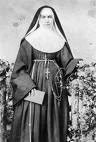
Mother Marianne’s generosity and courage were celebrated at her May 14, 2005, beatification in Rome. She was a woman who spoke “the language of truth and love” to the world, said Cardinal Jose Saraiva Martins, prefect of the Congregation for Saints’ Causes. Cardinal Martins, who presided at the beatification Mass in St. Peter’s Basilica, called her life “a wonderful work of divine grace.” Speaking of her special love for persons suffering from leprosy, he said, “She saw in them the suffering face of Jesus. Like the Good Samaritan, she became their mother.”
On January 23, 1838, a daughter was born to Peter and Barbara Cope of Hessen-Darmstadt, Germany. The girl was named after her mother. Two years later the Cope family immigrated to the United States and settled in Utica, New York. Young Barbara worked in a factory until August 1862, when she went to the Sisters of the Third Order of Saint Francis in Syracuse, New York. After profession in November of the next year, she began teaching at Assumption parish school.
Marianne held the post of superior in several places and was twice the novice mistress of her congregation. A natural leader, three different times she was superior of St. Joseph’s Hospital in Syracuse, where she learned much that would be useful during her years in Hawaii.
Elected provincial in 1877, Mother Marianne was unanimously re-elected in 1881. Two years later the Hawaiian government was searching for someone to run the Kakaako Receiving Station for people suspected of having leprosy. More than 50 religious communities in the United States and Canada were asked. When the request was put to the Syracuse sisters, 35 of them volunteered immediately. On October 22, 1883, Mother Marianne and six other sisters left for Hawaii where they took charge of the Kakaako Receiving Station outside Honolulu; on the island of Maui they also opened a hospital and a school for girls.
In 1888, Mother Marianne and two sisters went to Molokai to open a home for “unprotected women and girls” there. The Hawaiian government was quite hesitant to send women for this difficult assignment; they need not have worried about Mother Marianne! On Molokai she took charge of the home that Blessed Damien DeVeuster (d. 1889) had established for men and boys. Mother Marianne changed life on Molokai by introducing cleanliness, pride and fun to the colony. Bright scarves and pretty dresses for the women were part of her approach.
Awarded the Royal Order of Kapiolani by the Hawaiian government and celebrated in a poem by Robert Louis Stevenson, Mother Marianne continued her work faithfully. Her sisters have attracted vocations among the Hawaiian people and still work on Molokai.
Mother Marianne died on August 9, 1918.
Comment:
The government authorities were reluctant to allow Mother Marianne to be a mother on Molokai. Thirty years of dedication proved their fears unfounded. God grants gifts regardless of human short-sightedness and allows those gifts to flower for the sake of the kingdom.
The government authorities were reluctant to allow Mother Marianne to be a mother on Molokai. Thirty years of dedication proved their fears unfounded. God grants gifts regardless of human short-sightedness and allows those gifts to flower for the sake of the kingdom.

Quote:
Soon after Mother Marianne died, Mrs. John F. Bowler wrote in the Honolulu Advertiser, “Seldom has the opportunity come to a woman to devote every hour of 30 years to the mothering of people isolated by law from the rest of the world. She risked her own life in all that time, faced everything with unflinching courage and smiled sweetly through it all.”
Soon after Mother Marianne died, Mrs. John F. Bowler wrote in the Honolulu Advertiser, “Seldom has the opportunity come to a woman to devote every hour of 30 years to the mothering of people isolated by law from the rest of the world. She risked her own life in all that time, faced everything with unflinching courage and smiled sweetly through it all.”
COPYRIGHT: www.americancatholic.org
Gospel for this Sunday, January 17th, 2010.
GOSPEL John 2:1-11
There was a wedding at Cana in Galilee. The mother of Jesus was there, and Jesus and his disciples had also been invited. When they ran out of wine, since the wine provided for the wedding was all finished, the mother of Jesus said to him, 'They have no wine'. Jesus said 'Woman, why turn to me? My hour has not come yet.' His mother said to the servants, 'Do whatever he tells you'. There were six stone water jars standing there, meant for the ablutions that are customary among the Jews: each could hold twenty or thirty gallons. Jesus said to the servants, 'Fill the jars with water', and they filled them to the brim. 'Draw some out now' he told them 'and take it to the steward.' They did this; the steward tasted the water, and it had turned into wine. Having no idea where it came from - only the servants who had drawn the water knew - the steward called the bridegroom and said; 'People generally serve the best wine first, and keep the cheaper sort till the guests have had plenty to drink; but you have kept the best wine till now'.
There was a wedding at Cana in Galilee. The mother of Jesus was there, and Jesus and his disciples had also been invited. When they ran out of wine, since the wine provided for the wedding was all finished, the mother of Jesus said to him, 'They have no wine'. Jesus said 'Woman, why turn to me? My hour has not come yet.' His mother said to the servants, 'Do whatever he tells you'. There were six stone water jars standing there, meant for the ablutions that are customary among the Jews: each could hold twenty or thirty gallons. Jesus said to the servants, 'Fill the jars with water', and they filled them to the brim. 'Draw some out now' he told them 'and take it to the steward.' They did this; the steward tasted the water, and it had turned into wine. Having no idea where it came from - only the servants who had drawn the water knew - the steward called the bridegroom and said; 'People generally serve the best wine first, and keep the cheaper sort till the guests have had plenty to drink; but you have kept the best wine till now'.
This was the first of the signs given by Jesus: it was given at Cana in Galilee. He let his glory be seen, and his disciples believed in him.
Thought for the Day.
What shall I pray for
Sometimes people ask me this question:
“If God does not wish us to ask for material things, but for Himself, the Giver of all good, why does the Bible never say: ‘Do not pray for this or that, pray simply for the Holy Spirit?’ Why has this never been clearly expressed?”
I reply, “Because God knew that people would never begin to pray if they could not ask for earthly things like riches and health and honours; He says to Himself: ‘If they ask for such things the desire for something better will awaken in them, and finally they will only care about the higher things.’ ”
Sadhu Sundar Singh
Prayer
Voices from the Valley
Trinidad W.I.
“If God does not wish us to ask for material things, but for Himself, the Giver of all good, why does the Bible never say: ‘Do not pray for this or that, pray simply for the Holy Spirit?’ Why has this never been clearly expressed?”
I reply, “Because God knew that people would never begin to pray if they could not ask for earthly things like riches and health and honours; He says to Himself: ‘If they ask for such things the desire for something better will awaken in them, and finally they will only care about the higher things.’ ”
Sadhu Sundar Singh
Prayer
Voices from the Valley
Trinidad W.I.
Kids Corner, Second Sunday in Ordinary Time.


Don't forget! Next Sunday, January 24th, is the next Mass in our First Communion, Do This In Memory Program at 11.
14 January 2010
Cardinal Brady's Response to the Haiti Earthquake.
Cardinal Seán Brady, Archbishop of Armagh and Primate of All Ireland, issued the following statement in response to the human tragedy caused by the major earthquake in Haiti this morning:
I offer my prayerful support to the people of Haiti following the devastating earthquake in the early hours of this morning. The images and reports of the scale of human suffering experienced by Haitians has been very distressing, while the speed of devastation inflicted on the capital, Port-au-Prince, has been shocking.
My prayers are with those coming to terms with losing family members and friends. I ask for special prayers to be offered for the injured so that they may find the courage to rebuild their lives, and, that we remember in our prayers those who have died in Haiti due to this catastrophe.
I also ask for prayers of support to those providing emergency assistance and medical treatment to the injured and displaced.
Irish people have traditionally shown immense generosity in supporting relief agencies which give on the ground help to areas of devastation. I ask - while appreciating these are difficult times at home - that we once again show such selflessness in this hour of need for Haiti. Trócaire, the bishops’ overseas development agency, has opened an appeal* to help relieve the situation in Haiti.
Finally, I wish to reiterate this morning’s words by the Holy Father, Pope Benedict XVI, during his general audience address, when he has asked for prayers and support for the people of Haiti. Pope Benedict said: ‘My thoughts go in particular to the population hit just a few hours ago by a devastating earthquake which has caused serious loss of human life, large numbers of homeless and missing people, and vast material damage.
‘I invite everyone to join my prayers to the Lord for the victims of this catastrophe and for those who mourn their loss. I give assurances of my spiritual closeness to people who have lost their homes and to everyone who, in various ways, has been affected by this terrible calamity, imploring God to bring them consolation and relief in their suffering.
‘I appeal to the generosity of all people so that these our brothers and sisters who are experiencing a moment of need and suffering may not lack our concrete solidarity and the effective support of the international community. The Catholic Church will not fail to move immediately, through her charitable institutions, to meet the most immediate needs of the population.’
HELP NOW: http://www.trocaire.org/

I offer my prayerful support to the people of Haiti following the devastating earthquake in the early hours of this morning. The images and reports of the scale of human suffering experienced by Haitians has been very distressing, while the speed of devastation inflicted on the capital, Port-au-Prince, has been shocking.
My prayers are with those coming to terms with losing family members and friends. I ask for special prayers to be offered for the injured so that they may find the courage to rebuild their lives, and, that we remember in our prayers those who have died in Haiti due to this catastrophe.
I also ask for prayers of support to those providing emergency assistance and medical treatment to the injured and displaced.
Irish people have traditionally shown immense generosity in supporting relief agencies which give on the ground help to areas of devastation. I ask - while appreciating these are difficult times at home - that we once again show such selflessness in this hour of need for Haiti. Trócaire, the bishops’ overseas development agency, has opened an appeal* to help relieve the situation in Haiti.
Finally, I wish to reiterate this morning’s words by the Holy Father, Pope Benedict XVI, during his general audience address, when he has asked for prayers and support for the people of Haiti. Pope Benedict said: ‘My thoughts go in particular to the population hit just a few hours ago by a devastating earthquake which has caused serious loss of human life, large numbers of homeless and missing people, and vast material damage.
‘I invite everyone to join my prayers to the Lord for the victims of this catastrophe and for those who mourn their loss. I give assurances of my spiritual closeness to people who have lost their homes and to everyone who, in various ways, has been affected by this terrible calamity, imploring God to bring them consolation and relief in their suffering.
‘I appeal to the generosity of all people so that these our brothers and sisters who are experiencing a moment of need and suffering may not lack our concrete solidarity and the effective support of the international community. The Catholic Church will not fail to move immediately, through her charitable institutions, to meet the most immediate needs of the population.’
HELP NOW: http://www.trocaire.org/


13 January 2010
Help the Cystic Fibrosis Association.

The Galway Branch of the Cystic Fibrosis Association are holding their church gate collection this weekend and would appreciate your support. Cystic Fibrosis is a life threatning genetic disease which affects the lungs and digestive system of over 1100 children and young adults in Ireland.
More information from the Galway Branch can be contacted at 091- 846272 or 086- 8178552
The national website is http://www.cfireland.ie/
Celebration at Poor Clare Monastery.
Celebration Weekend in the Poor Clare Monastery 16th and 17th January 2010 to celebrate the newly refurbished Extern Convent. The event is an opportunity for viewing the work done and meeting the sisters. The doors are open from 2-5pm Saturday 16th and 2-5pm Sunday 17th January and refreshments are available. At 3pm... on Saturday, we are picking the winners of our “Buy a Brick” Grand Draw. At 3pm on Sunday we will have the official blessing kindly performed by the Bishop of Galway. It should be noted that there will be no extra parking available on the grounds of the monastery on the day. All are welcome.

http://www.poorclares.ie/

12 January 2010
Vocations Workshop.
A Vocations Workshop for the diocesan priesthood has again been organised in conjunction with the Archdiocese of Tuam and the Diocese of Clonfert. It will run held from February 19th to February 21st . Those intrested in finding out more about being a priest here in the West should, in the first instance, make contact with me:
Fr. Diarmuid Hogan
Of course here in Sacred Heart Monsignor Malachy, Fr. David and Sr. Catherine are always happy to meet with anyone considering a vocation.
Fr. Diarmuid Hogan
Dean of Chaplaincy Services
NUI, Galway
Tel. +353 91 495055
11 January 2010
Senior Help Line.
‘Do you need someone to talk to? Senior Help Line is a confidential listening service for older people by older people for the price of a local call anywhere in Ireland, LoCall 1850 440 444.
Senior Help Line is open every day from 10 am till 4 pm and 7 pm till 10 pm, 365 days a year.
‘Older people call us for many reasons.. They may feel lonely, isolated or have family or health worries. A small proportion may fear or be experiencing elder abuse, or are depressed and feel they don’t have the strength to carry on.
‘Senior Help Line ‘s trained older volunteers offer a friendly, listening and non-judgmental ear to all callers. So don't be alone with your problem. Lifting the phone lessens the loneliness. We will be waiting for your call. LoCall 1850 440 444’.

www.seniorhelpline.ie
Senior Help Line is open every day from 10 am till 4 pm and 7 pm till 10 pm, 365 days a year.
‘Older people call us for many reasons.. They may feel lonely, isolated or have family or health worries. A small proportion may fear or be experiencing elder abuse, or are depressed and feel they don’t have the strength to carry on.
‘Senior Help Line ‘s trained older volunteers offer a friendly, listening and non-judgmental ear to all callers. So don't be alone with your problem. Lifting the phone lessens the loneliness. We will be waiting for your call. LoCall 1850 440 444’.

9 January 2010

Mass Intentions, Week of January 10th 2010.
Saturday, January 9th, Vigil Mass, 7:30 PM, Frank and Mary Nally.
Sunday, January 10th, 9:30, No Intention.
11:00, 1. Michael Comber. 2. Mabel and Paddy Walsh.
12:15, Paschal Lally and Deceased of Lally and Noone Families.
2:00, SPECIAL MASS OWING TO THE ADVERSE WEATHER.
6:30, Mary Kate and Martin Fleming.
Monday, January 11th, 10:00, Baby Annaleigh Cleere.
Tuesday, January 12th, 10:00, All our sick.
Wednesday, January 13th, 10:00, No Intention.
Thursday, January 14th, 10:00, No Intention.
Friday, January 15th, 10:00, Thomas and Josephine McWilliams.
Saturday, January 16th, 11:00, Months Mind Mass, Ann Small.
Vigil Mass, 7:30, 1. Mary Forde. 2. Dolly Gavin, Months Mind Mass.
Sunday, January 17th, 9:30, Kevin Fitzgerald.
11:00, Deceased members of the Cahill Family.
12:15, Pauline Caulfield and her brother Michael James McGuire.
6:30, 1. Chris and Joe Fitzpatrick. 2. Michael O'Malley and deceased of O'Connell and McGrory Families.
Sunday, January 10th, 9:30, No Intention.
11:00, 1. Michael Comber. 2. Mabel and Paddy Walsh.
12:15, Paschal Lally and Deceased of Lally and Noone Families.
2:00, SPECIAL MASS OWING TO THE ADVERSE WEATHER.
6:30, Mary Kate and Martin Fleming.
Monday, January 11th, 10:00, Baby Annaleigh Cleere.
Tuesday, January 12th, 10:00, All our sick.
Wednesday, January 13th, 10:00, No Intention.
Thursday, January 14th, 10:00, No Intention.
Friday, January 15th, 10:00, Thomas and Josephine McWilliams.
Saturday, January 16th, 11:00, Months Mind Mass, Ann Small.
Vigil Mass, 7:30, 1. Mary Forde. 2. Dolly Gavin, Months Mind Mass.
Sunday, January 17th, 9:30, Kevin Fitzgerald.
11:00, Deceased members of the Cahill Family.
12:15, Pauline Caulfield and her brother Michael James McGuire.
6:30, 1. Chris and Joe Fitzpatrick. 2. Michael O'Malley and deceased of O'Connell and McGrory Families.
SPECIAL MASS TOMORROW OWING TO THE BIG FREEZE.
This is the coldest snap since 1963 and we are mindful of how difficult it is for you to attend church. With this in mind, we are putting on a special Mass tomorrow, Sunday, January 10th, at 2 PM. This should make it easier if you can't get here in the morning, although all the other Masses are at the normal times.
Kids Corner, The Baptism of Jesus.

COPYRIGHT: www.sermons4kids.com
ATTENTION KIDS! AS THE SCHOOLS REMAIN CLOSED UNTIL THURSDAY WITH THE BIG FREEZE, ASK YOURSELF WHAT YOU CAN DO TO HELP MUM AND DAD AROUND THE HOUSE OR MAYBE AN OLDER PERSON. CAN YOU HELP CLEAR THE SNOW FROM THE DRIVEWAY OR HELP WITH THE SHOPPING? BE VERY CAREFUL ON THE PATHS THOUGH, THEY ARE SLIPPY!
Saint of the Week, Blessed André Bessette.

At 25, he applied for entrance into the Congregation of the Holy Cross. After a year’s novitiate, he was not admitted because of his weak health. But with an extension and the urging of Bishop Bourget (see Marie-Rose Durocher, October 6), he was finally received. He was given the humble job of doorkeeper at Notre Dame College in Montreal, with additional duties as sacristan, laundry worker and messenger. “When I joined this community, the superiors showed me the door, and I remained 40 years.”
In his little room near the door, he spent much of the night on his knees. On his windowsill, facing Mount Royal, was a small statue of St. Joseph, to whom he had been devoted since childhood. When asked about it he said, “Some day, St. Joseph is going to be honored in a very special way on Mount Royal!”
When he heard someone was ill, he visited to bring cheer and to pray with the sick person. He would rub the sick person lightly with oil taken from a lamp burning in the college chapel. Word of healing powers began to spread.
When an epidemic broke out at a nearby college, André volunteered to nurse. Not one person died. The trickle of sick people to his door became a flood. His superiors were uneasy; diocesan authorities were suspicious; doctors called him a quack. “I do not cure,” he said again and again. “St. Joseph cures.” In the end he needed four secretaries to handle the 80,000 letters he received each year.
For many years the Holy Cross authorities had tried to buy land on Mount Royal. Brother André and others climbed the steep hill and planted medals of St. Joseph. Suddenly, the owners yielded. André collected 200 dollars to build a small chapel and began receiving visitors there—smiling through long hours of listening, applying St. Joseph’s oil. Some were cured, some not. The pile of crutches, canes and braces grew.
The chapel also grew. By 1931 there were gleaming walls, but money ran out. “Put a statue of St. Joseph in the middle. If he wants a roof over his head, he’ll get it.” The magnificent Oratory on Mount Royal took 50 years to build. The sickly boy who could not hold a job died at 92.
He is buried at the Oratory and was beatified in 1982.
Comment:
Rubbing ailing limbs with oil or a medal? Planting a medal to buy land? Isn’t this superstition? Aren’t we long past that? Superstitious people rely only on the “magic” of a word or action. Brother André’s oil and medals were authentic sacramentals of a simple, total faith in the Father who lets his saints help him bless his children.
Quote:
“It is with the smallest brushes that the artist paints the most exquisitely beautiful pictures,” said Blessed André Bessette.Quote:
COPYRIGHT: www.americancatholic.org
Invitation to all who celebrated Baptism in 2009.
This Sunday we invite all those who celebrated a Baptism in the Sacred Heart to join us for one of our Masses, 7:30, Saturday and Sunday at 9:30, 11, 12:15 and 6:30. There will be a warm welcome and special prayers. This is also an important opportunity to express gratitude to all the members of our Baptismal Team who work so hard all year to prepare families for the sacrament.
The Feast of The Lord's Baptism, Sunday, January 10th.

In the Eastern Church this feast is called Theophany because at the baptism of Christ in the River Jordan God appeared in three persons. The baptism of John was a sort of sacramental preparatory for the Baptism of Christ. It moved men to sentiments of repentance and induced them to confess their sins. Christ did not need the baptism of John. Although He appeared in the "substance of our flesh" and was recognized "outwardly like unto ourselves", He was absolutely sinless and impeccable. He conferred upon the water the power of the true Baptism which would remove all the sins of the world: "Behold the Lamb of God, behold Him Who takes away the sin of the world".
Many of the incidents which accompanied Christ's baptism are symbolical of what happened at our Baptism. At Christ's baptism the Holy Spirit descended upon Him; at our Baptism the Trinity took its abode in our soul. At His baptism Christ was proclaimed the "Beloved Son" of the Father; at our Baptism we become the adopted sons of God. At Christ's baptism the heavens were opened; at our Baptism heaven was opened to us. At His baptism Jesus prayed; after our Baptism we must pray to avoid actual sin.
- Right Rev. Msgr. Rudolph G. Bandas
ARTICLE COPYRIGHT: www.catholicculture.org
Sympathies and Month's Minds.
We have two Months Mind Masses coming up this week:
1. Ann Small, Cuar na Lus and formerly of Anglingham, Castlegar, Saturday, January 16th, at 11.
2. Dolly Gavin, Fursey Road, Saturday, January 16th, at 7:30.
Your prayers are asked for the repose of the souls of the following:
1. Richie Cazabon, Moycullen and formerly of Highfield Park, whose Funeral Mass took place in St. Joseph's during the week.
2. Frank Moran, Dun Laoghaire, the nephew of Tess Donohoe, Fr. David's housekeeper.
Please pray for all at this time who are missing a loved one. May their faith be their consolation.
1. Ann Small, Cuar na Lus and formerly of Anglingham, Castlegar, Saturday, January 16th, at 11.
2. Dolly Gavin, Fursey Road, Saturday, January 16th, at 7:30.
Your prayers are asked for the repose of the souls of the following:
1. Richie Cazabon, Moycullen and formerly of Highfield Park, whose Funeral Mass took place in St. Joseph's during the week.
2. Frank Moran, Dun Laoghaire, the nephew of Tess Donohoe, Fr. David's housekeeper.
Please pray for all at this time who are missing a loved one. May their faith be their consolation.
7 January 2010
Dance Classes in Shantalla.
The McCole School of Irish Dance resumes classes for children in St.
Joseph’s Community Centre Shantalla on Thursday 14th January 2010. New
members welcome. Adult Irish Dance Classes resume in City Centre on Monday
11th and Wednesday 13th January 2010 also. For more information call
085-1601601 or see http://www.danceforlife.ie/
Joseph’s Community Centre Shantalla on Thursday 14th January 2010. New
members welcome. Adult Irish Dance Classes resume in City Centre on Monday
11th and Wednesday 13th January 2010 also. For more information call
085-1601601 or see http://www.danceforlife.ie/
5 January 2010
The Solemnity of the Epiphany, Nollaig na mBan.
Our Masses today, Vigil Mass, January 5th at 7:30.
January 6th, 10:00, 11:30 and 6:30.
The Epiphany is the manifestation of Jesus as Messiah of Israel, Son of God and Saviour of the world. The great feast of Epiphany celebrates the adoration of Jesus by the wise men (magi) from the East, together with his baptism in the Jordan and the wedding feast at Cana in Galilee. In the magi, representatives of the neighbouring pagan religions, the Gospel sees the first-fruits of the nations, who welcome the good news of salvation through the Incarnation' (Catechism of the Catholic Church, 528).
January 6th, 10:00, 11:30 and 6:30.
The Epiphany is the manifestation of Jesus as Messiah of Israel, Son of God and Saviour of the world. The great feast of Epiphany celebrates the adoration of Jesus by the wise men (magi) from the East, together with his baptism in the Jordan and the wedding feast at Cana in Galilee. In the magi, representatives of the neighbouring pagan religions, the Gospel sees the first-fruits of the nations, who welcome the good news of salvation through the Incarnation' (Catechism of the Catholic Church, 528).
In celebration of the feast of the Epiphany here in Ireland, January 6th is marked by Nollaig na mBan or Women's Christmas. On this day it is the tradition for the women to get together and enjoy their own Christmas, while the men folk stay at home and handle all the chores.

4 January 2010
Coming up in Croí Nua this month, January 2010.
BIBLE COURSE IN CROI NUA Beginning on Tuesday 12thJanuary 10.15 morning and 7.30 in the evening |
GOOD NEWS EACH SUNDAY Reflection on Sunday readings begins Thursday 14th January 7.30p.m. |
Croi Nua
Rosary Lane
Taylor’s Hill
GALWAY
(091) 520960 or 087 6833195
email: croinuacentre at eircom.net
Croí Nua Spirituality Centre is run by the Missionaries of the Sacred Heart, and is situated on Rosary Lane in Taylors Hill, opposite the entrance to the Dominican Convent Primary and Secondary School. The no. 2 bus passes by the gate.
1 January 2010
Happy New Year!
'Rejoice in The Lord always, again I say rejoice.'
Sympathies, Ruth Brown, New Avenue.
Your prayers are asked today for the repose of the soul of Ruth Brown, New Avenue, who has died. Ruth's remains will be reposing at Conneely's Funeral Home on Flood Street, this New Year's Day from 5 until 6:30, when they will be removed to our church. Ruth's Funeral Mass will be tomorrow at 12 Noon, followed by burial in The New Cemetery, Bohermore..
We have two Months Minds Mass this weekend, tomorrow, January 2nd, Eileen Spelman at 11, and Sunday, January 3rd, Shane Rabbitte at 12:15.
We blow out the candle because the dawn has come.'
We have two Months Minds Mass this weekend, tomorrow, January 2nd, Eileen Spelman at 11, and Sunday, January 3rd, Shane Rabbitte at 12:15.
We blow out the candle because the dawn has come.'
Communion Calls.
As today, while being the First Friday, is New Year's Day, we are doing our Communion Calls next week, January 7th and 8th. Father David will be doing his on Thursday afternoon and Friday morning, and Monsignor Malachy on Friday.
Mass Intentions, Week of January 3rd 2010.
Saturday, January 2nd, 11:00, Eileen Spelman, Months Mind Mass.
12 Noon, Funeral Mass, Ruth Brown, New Avenue.
Vigil Mass, 7:30, Second Sunday of Christmas, Mary Tierney.
Sunday, January 3rd, 9:30, Doherty and McKee Families, Deceased.
11:00, Deceased Members of the Reidy Family.
12:15, Shane Rabbitte, Months Mind Mass.
6:30, Edna Waldron.
Monday, January 4th, 10:00, Dolan and Grealish Families.
Tuesday, January 5th, 10:00, All our sick.
Vigil Mass, 7:30, Solemnity of the Epiphany, 7:30, Pat and John Joe Ward and Patrick and Mary Lawrence.
Wednesday, January 6th, 10:00 Denis Hynes.
11:30, Rita and Bernard Burke.
6:30, Cecil Ennis.
Thursday, January 7th, 10:00.
Friday, January 8th, 10:00.
Saturday, January 9th, Vigil Mass, The Baptism of The Lord, 7:30, Frank and Mary Nally.
Sunday, January 10th, 9:30.
11:00, Michael Comber.
12:15, Paschal Lally and deceased of Lally and Noone Families.
6:30, Mary Kate and Martin Fleming.
12 Noon, Funeral Mass, Ruth Brown, New Avenue.
Vigil Mass, 7:30, Second Sunday of Christmas, Mary Tierney.
Sunday, January 3rd, 9:30, Doherty and McKee Families, Deceased.
11:00, Deceased Members of the Reidy Family.
12:15, Shane Rabbitte, Months Mind Mass.
6:30, Edna Waldron.
Monday, January 4th, 10:00, Dolan and Grealish Families.
Tuesday, January 5th, 10:00, All our sick.
Vigil Mass, 7:30, Solemnity of the Epiphany, 7:30, Pat and John Joe Ward and Patrick and Mary Lawrence.
Wednesday, January 6th, 10:00 Denis Hynes.
11:30, Rita and Bernard Burke.
6:30, Cecil Ennis.
Thursday, January 7th, 10:00.
Friday, January 8th, 10:00.
Saturday, January 9th, Vigil Mass, The Baptism of The Lord, 7:30, Frank and Mary Nally.
Sunday, January 10th, 9:30.
11:00, Michael Comber.
12:15, Paschal Lally and deceased of Lally and Noone Families.
6:30, Mary Kate and Martin Fleming.
Subscribe to:
Posts (Atom)